
Find emulsions by browsing the list below. This Anthotype database of emulsions will grow each year on Anthotype Day when artists add to the knowledge-bank. It can be used for free, but if you can, please support this resource by becoming a supporting member. Much appreciated!
Emulsions 2022 | 2023 | 2024 | 2025 | List of ALL emulsions ever
Anthotype emulsions A-Z from 2026
Guelder rose (Viburnum opulus) anthotype by Judith IJland
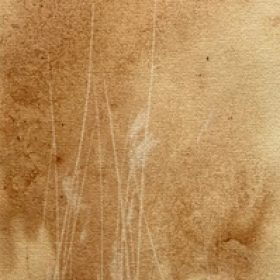
“Swaying reeds” by Judith IJland, The Netherlands
Parts used: Dried berries
Amount: A handful
Extracted by: Trituration in a mortar
Solvent: Tap water and 70% alcohol
Application: Soaking for 3 hours
Guelder rose (Viburnum opulus) anthotype by Yulia Kapustynska
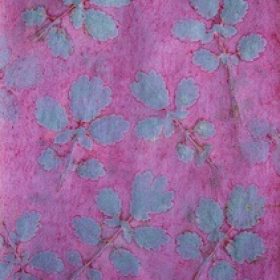
“Greater Celandine” by Yulia Kapustynska, Village of Pohybliak, Cherkasy Oblast, Ukraine
Parts used: Red guelder rose berries
Amount: Two handfuls for each print
Extracted by: Mortar
Solvent: None, just the natural juice from the berries
Application: Brushing
Happy wanderer (Hardenbergia violacea) anthotype by Wendy Currie
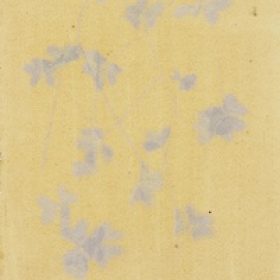
“Hardenbergia” by Wendy Currie, Melbourne, Australia
Parts used: Petals
Amount: 2 tablespoons
Extracted by: Mortar and soaking
Solvent: Alcohol – Vodka
Application: Brushing with sponge paddle
Haskap (Lonicera caerulea) anthotype by Dianne Bos
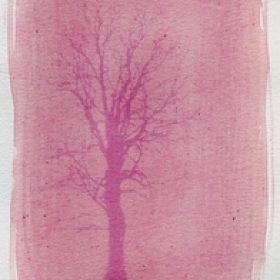
“Winter Tree” by Dianne Bos, Kingston, Ontario, Canada
Parts used: Berries
Amount: About 8 berries or 2 tablespoons
Extracted by: Mortar and soaking
Solvent: Alcohol – vodka
Application: Brush
Haskap (Lonicera caerulea) anthotype by Janie Julien-Fort
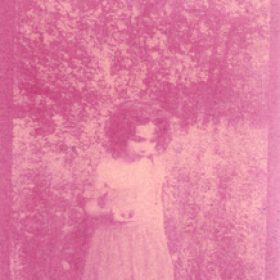
“Lucie with a Butterfly” by Janie Julien-Fort, Montreal, Canada
Parts used: Berry juice
Amount: 2 tablespoons
Extracted by: The berries were frozen; I used the juice.
Solvent: None
Application: Brushing
Heather, common (Calluna vulgaris) anthotype by Caroline Walshe
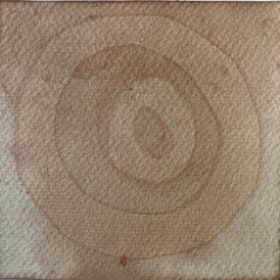
“Patience” by Caroline Walshe, County Roscommon, Ireland
Parts used: Whole plant
Amount: 2 very big handfuls
Extracted by: Simmered for several hours and left to sit for a day
Solvent: Rainwater
Application: Dipping and soaking for a few hours
Heliotrope, Garden (Heliotropium arborescens) anthotype by Christine Acebo

“Pony Walking in a Snowy Field” by Christine Acebo, Ashford, Connecicut, USA
Parts used: Petals
Amount: Petals from flowers of 5 flower clusters
Extracted by: Mortar
Solvent: Alcohol (vodka)
Application: Brushing
Indigo milk cap (Lactarius indigo) anthotype by Mickey Mariash

“Whimsical Mushrooms” by Mickey Mariash, Great Barrington, Massachusetts, USA
Parts used: Mushroom cap
Amount: 1 large mushroom cap
Extracted by: Simmering
Solvent: Tap water
Application: Brushing
Iris (Iris germanica) anthotype by Zsófia Seress
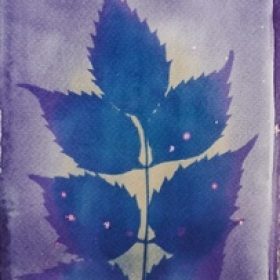
“Under the Greek Sun” by Zsófia Seress, Göd, Hungary
Parts used: Petals
Amount: A handful for each print
Extracted by: Mortar
Solvent: Alcohol (ethanol)
Application: Brushing
Ironweed, common (Vernonia fasciculata) anthotype by JoLynne Walz Martinez
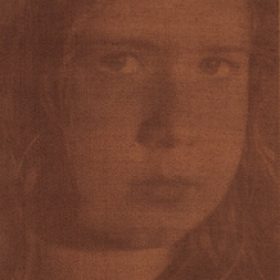
“Elly” by JoLynne Walz Martinez, Village of Oaks, Missouri, USA
Parts used: Petals, Bracts and Stems
Amount: About one cup
Extracted by: Food Processor
Solvent: Rum
Application: Brushing
Jacaranda (Jacaranda mimosifolia) anthotype by Stina
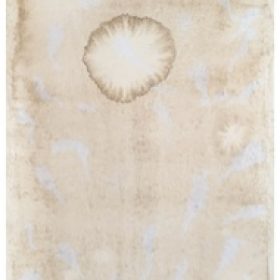
“Dusty Dry Floor Blooms” by Stina, Ciudad de México, México
Parts used: Petals
Amount: A small plastic shopping bag of petals
Extracted by: Soaking, cooking, straining
Solvent: Tap water
Application: Brushing
Jamun (Syzygium cumini) anthotype by Stephanie Lima
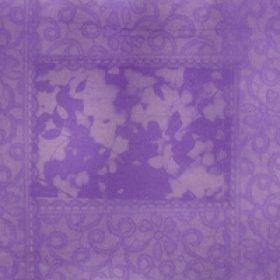
“Ecosynchronicity” by Stephanie Lima, Rio de Janeiro, Brazil
Parts used: Fruit skin and pulp
Amount: 8 berries
Extracted by: Mashing in a mortar and pestle
Solvent: Tap water and 45% alcohol
Application: Brushing with a soft foam paintbrush
Japanese stiltgrass (Microstegium vimineum) anthotype by Schuyler Kogan
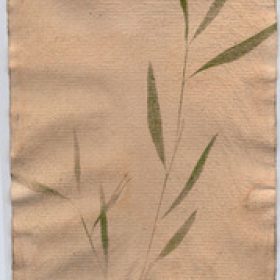
“Stiltgrass on Stiltgrass on Stiltgrass” by Schuyler Kogan, Woodbury, Connecticut, USA
Parts used: Leaves and stems
Amount: ~200 mL
Extracted by: Blender
Solvent: Isopropyl alcohol
Application: Dabbing with sponge paintbrush
Kawakawa (Piper excelsum) anthotype by Rosemary Horn
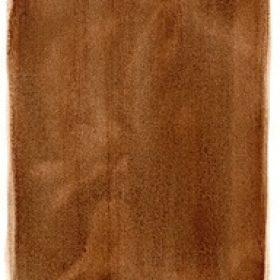
“Kawakawa Test 1” by Rosemary Horn, Nelson, New Zealand
Parts used: Leaves
Amount: Approximately two handfuls
Extracted by: Hand-cranked wheatgrass juicer
Solvent: Isopropyl alcohol
Application: Brushing
Lantana (Lantana camara) anthotype by Nan Wollman

“Untitled” by Nan Wollman, Tucson, Arizona, USA
Parts used: Flowers
Amount: 5 grams of petals
Extracted by: Mashed with alcohol
Solvent: 30 mL alcohol
Application: Poured emulsion over paper
Lantana (Lantana camara) anthotype by Patricio Ceriani
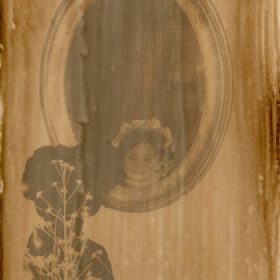
“Alter Ego” by Patricio Ceriani, Merlo, San Luis, Argentina
Parts used: Fruit
Amount: A handful (five or six fruit clusters like shown in the picture)
Extracted by: Mortar
Solvent: Tap water
Application: Brushing
Lily of the valley (Convallaria majalis) anthotype by Amy Flatow
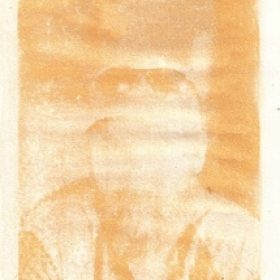
“Portrait of Max” by Amy Flatow, Woodbourne, New York, USA
Parts used: Berries
Amount: A handful of berries
Extracted by: Mortar
Solvent: Vodka
Application: Brushing
Lupin (Lupinus polyphyllus) anthotype by Ulf Rehnholm
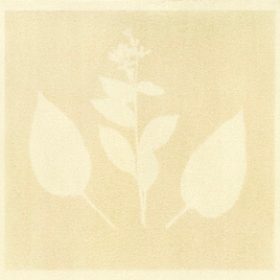
“Lungört” by Ulf Rehnholm, Eskilstuna, Sweden
Parts used: Petals, stem and leaves
Amount: A handful for each print
Extracted by: Mortar
Solvent: Alcohol
Application: Brushing
Malabar spinach (Basella rubra) anthotype by Mónica Páez
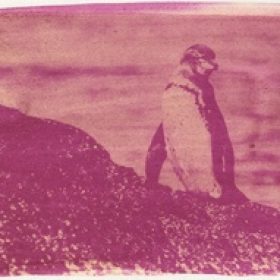
“Equatorial penguin” by Mónica Páez, Galápagos Islands, Ecuador
Parts used: Fruits
Amount: 1 tablespoon
Extracted by: Mortar
Solvent: Alcohol (crafted sugar cane 45%)
Application: Brushing
Maple, red (Acer platanoides) anthotype by Laurinda Bellew
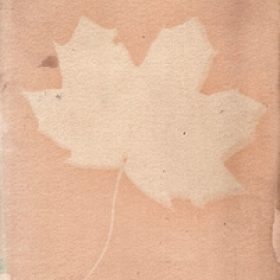
“Red Maple” by Laurinda Bellew, Wiltshire, UK
Parts used: Leaves
Amount: Three large leaves
Extracted by: Mortar
Solvent: Tap water
Application: Brushing
Melon, Santa Claus (Cucumis melo) anthotype by Marta Palau Franco
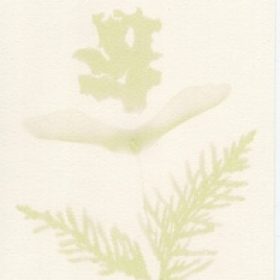
“Summer melon flower” by Marta Palau Franco, Luxembourg
Parts used: Rind
Amount: 3 tablespoons of the rind paste
Extracted by: Peeling and grinding the rind, and mixing the paste
Solvent: 50 mL alcohol, isopropanol 99.9%
Application: Brushing with a foam brush
Mint (Mentha) anthotype by İlhan Sadıkoğlu
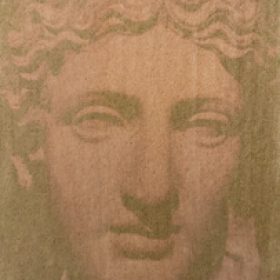
“Untitled” by İlhan Sadıkoğlu, İstanbul, Turkey
Parts used: The stems and the leaves
Amount: 2 tablespoons
Extracted by: Blender
Application: Brushing
Mix of Blueberry (Vaccinium sect. cyanococcus) and Feverfew (Tanacetum parthenium) anthotype by Caro Blount-Shah

“Ferns Unfurled” by Caro Blount-Shah, Bradford, UK
Parts used: Petals of feverfew flowers and blueberry fruits
Amount: A handful of each for each print, approximately 2 tablespoons
Extracted by: Mortar and sieve
Thinner: Filtered water for mashing, then a teaspoon of Gin when sieving
Application: Brushing
Mix of Breadfruit (Artocarpus altilis), Sorrel, red (Rumex acetosella) and Turmeric (Curcuma longa) anthotype by Dominique Alexandria [Simmonds]
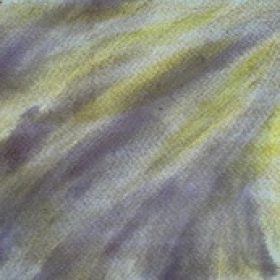
“Fanned Out” by Dominique Alexandria [Simmonds], Rochester, New York, USA
Parts used: Peels, dried petals and powder
Amount: A very small amount per print in liquid form
Extracted by: Cooking the breadfruit skins and the sorrel leaves
Solvent: Tap water and alcohol
Application: Brushing
Mix of Butterfly pea (Clitoria ternatea) and Peony ‘Inspecteur Lavergne’ (Paeonia lactiflora ‘Inspecteur Lavergne’) anthotype by Émilie Léger
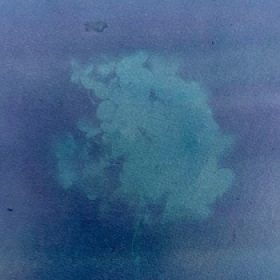
“Spring Revealed in Autumn Light” by Émilie Léger, Southwestern Québec, Canada
Parts used: Flower petals only, from dried peony and butterfly pea flowers
Amount: Petals from one dried ‘Inspecteur Lavergne’ peony flower and one handful of dried butterfly pea flowers, combined for a single botanical emulsion
Extracted by: Cooking. Both flowers were boiled together in a small quantity of water to extract their pigments
Solvent: A small quantity of water
Application: Three generous, hand-applied coats
Mix of Butterfly pea (Clitoria ternatea) and Spirulina (Spirulina maxima) anthotype by Andie Dale
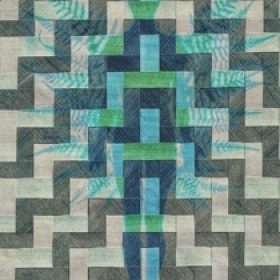
“Woven Butterfly Angel” by Andie Dale, United Kingdom
Parts used: Powder
Extracted by: Mixing
Solvent: Tap water
Application: Sponge brush
Mix of Elderberry (Sambucus nigra) and Jamun (Syzygium cumini) anthotype by Ray Harris

“Two’s company” by Ray Harris, Bristol, UK
Parts used: Fresh berries
Amount: A handful for each print
Extracted by: Just pressing fruit directly onto the paper
Solvent: None
Application: Pressing fruit directly onto paper, light brushing
Mix of Madagascar periwinkle (Catharanthus roseus) and Mexican fan palm (Washingtonia robusta) anthotype by Bengisu Çaygür

“Self-portrait” by Bengisu Çaygür, Silifke/Mersin, Turkey
Parts used: Petals and Bark
Amount: Madagascar periwinkle: 3 tablespoons of petals. Mexican fan palm bark: a medium-sized cooking pot, loosely packed (approx. 80 mL of reduced extract)
Extracted by: Madagascar periwinkle: Boiled the petals in water until the colour concentrated into a deep fuchsia emulsion. The petals were removed, and the extract was reduced over low heat and filtered through cheesecloth. Mexican fan palm bark: The cleaned bark was boiled in water, then filtered twice through cheesecloth to remove the resin before reducing over low heat. This produced a dense, rich colour.
Solvent: Tap water
Application: Brushing (synthetic brush)
Mix of Mullein (Verbascum thapsus) and Snowbrush ceanothus (Ceanothus velutinus) anthotype by Dietlinde DuPlessis
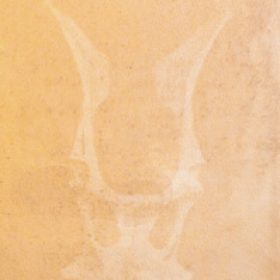
“Pelvis” by Dietlinde DuPlessis, Laramie, Wyoming and Tucson, Arizona, USA
Parts used: Leaves
Amount: A few leaves
Extracted by: Mortar
Solvent: Tap water
Application: Dipping
Mix of Pumpkin, blue ballet (Cucurbita maxima) and Squash, butternut (Cucurbita moschata) anthotype by Lucija Marin
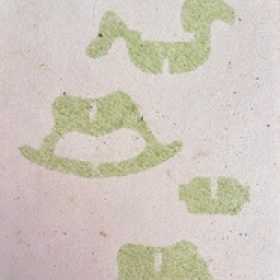
“Cavallo a dondolo scomposto” by Lucija Marin, Zagreb, Croatia
Parts used: Leaves
Amount: A handful for a few prints
Extracted by: Boiling with a pinch of sodium bicarbonate, then mashed in a mortar
Solvent: Tap water and sodium bicarbonate, vodka for the mortar extraction
Application: Brushing and gentle rubbing
Mix of Sangria fruits anthotype by Teresa Guxens

“Soft Sangria” by Teresa Guxens, Barcelona, Spain
Parts used: Pieces of apple, beetroot, raisins, orange, and hibiscus (Malus domestica, Beta vulgaris, Vitis vinifera, Citrus, Malvaceae)
Amount: 34 grams of infusion for each print
Extracted by: Mixer
Thinner: Gin
Application: Brushing
Mullein (Verbascum thapsus) anthotype by Jen Perena
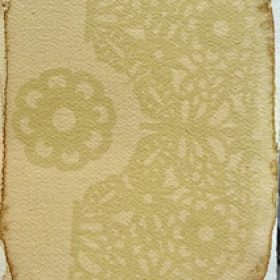
“Papery Lace” by Jen Perena, Rochester, New York, USA
Parts used: Dried flowers
Amount: 2 tablespoons
Extracted by: Boiling (to make tea)
Solvent: Tap water
Application: Brushing
Oregon grape (Mahonia aquifolium) anthotype by Kriszta Németh
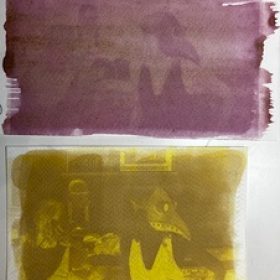
“Fotófalu” by Kriszta Németh, Törökbálint, Hungary
Parts used: Berries / Bark of stem and root
Amount: About a half handful for each print (berries) / Stem and root cut into approximately 10 cm pieces
Extracted by: Simple pressing (berries) / Soaking in alcohol (bark of stem and root)
Thinner: None for berries / Pure Ethanol for bark and root
Application: Brushing
Layers: 1 for berries / 3 for bark of stem and root
Parsley, Italian (Petroselinum crispum) anthotype by Liz Wass
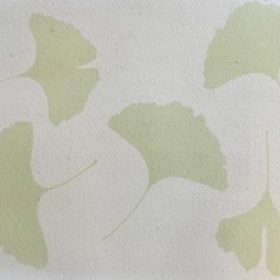
“Ginkgo” by Liz Wass, British Columbia, Canada
Amount: A handful of chopped leaves and stems
Extracted by: Soaking
Solvent: Isopropyl 70% alcohol
Application: Brushing
Pitaya / Cardon (Stenocereus griseus) anthotype by Viri Florentti
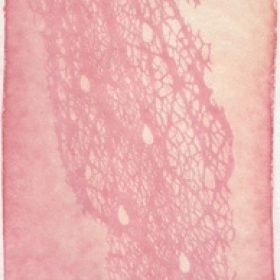
“Tuna roja” by Viri Florentti, Hidalgo, Mexico
Parts used: Fruit
Amount: 1 fruit
Extracted by: Mortar
Solvent: Ethyl alcohol
Application: Brushing
Plumbago, blue (Plumbago auriculata) anthotype by Jessica Curry
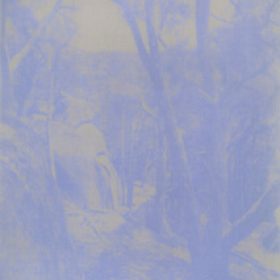
“Dog Rocks” by Jessica Curry, Melbourne, Australia
Parts used: Petals
Amount: A handful for each print
Extracted by: Stick blender after soaking for 30 minutes
Solvent: Alcohol (Smirnoff vodka)
Application: Brushing
Potato (Solanum tuberosum) anthotype by Katia Weibel
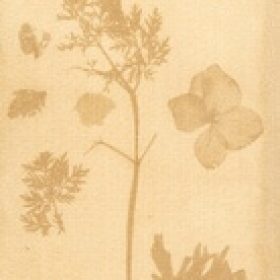
“Delicate Flowers” by Katia Weibel, Näfels, Switzerland
Parts used: Peels
Amount: Peels of 3 potatoes (2 handfuls)
Extracted by: Cut into small pieces
Solvent: Alcohol
Application: Brushing
Purple heart (Tradescantia pallida) anthotype by Ren Suchyta-Korany

“Rollie #4” by Ren Suchyta-Korany, Indiana, USA
Parts used: 80% petals / 20% stems and leaves
Amount: 2 tablespoons
Extracted by: Soaking
Solvent: Alcohol 70%
Application: Brushing
Red lion (Amaryllis hippeastrum) anthotype by Donna Moore

“Sassafras” by Donna Moore, Blaine, Tennessee, USA
Parts used: Petals
Amount: One blossom
Extracted by: Mortar and soaking
Solvent: 91% isopropyl alcohol
Application: Brushing with foam brush
Reed, common (Phragmites australis) anthotype by Jeffrey Kogan
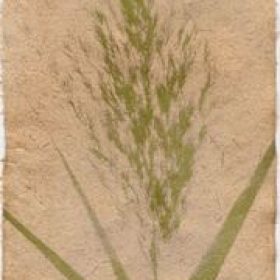
“Phragmites on Phragmites on Phragmites” by Jeffrey Kogan, Woodbury, Connecticut, USA
Parts used: Leaves
Amount: ~200 mL
Extracted by: Blender
Solvent: Isopropyl alcohol
Application: Dabbing with sponge paintbrush


 Rated 9,8 - based on 224 votes


 Rated 10 - based on 8 votes

 World Anthotype Day
 World Cyanotype Day


