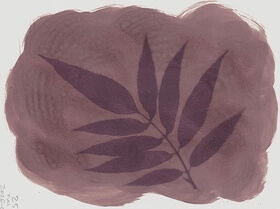
“Ebulus leaves” by Gabriele Coassin, Venetian countryside, Italy
Parts used: Whole berries
Amount: A handful for each A4 print
Extracted by: Wrapped in cotton wool and pressed with a potato masher
Solvent: None
Application: Brushing

“Ebulus leaves” by Gabriele Coassin, Venetian countryside, Italy
Parts used: Whole berries
Amount: A handful for each A4 print
Extracted by: Wrapped in cotton wool and pressed with a potato masher
Solvent: None
Application: Brushing
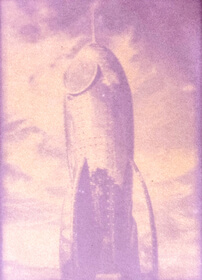
“3,2,1 Ignition…” By Toni Harris, Rutherglen, Victoria, Australia
Parts used: Wine
Amount: Approximately 200 mL
Extracted by: Pouring directly from the bottle
Application: Paper floated on top of the wine in a dish for about 2 hours
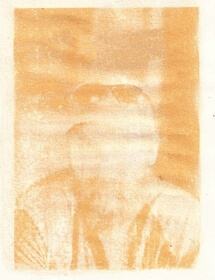
“Portrait of Max” by Amy Flatow, Woodbourne, New York, USA
Parts used: Berries
Amount: A handful of berries
Extracted by: Mortar
Solvent: Vodka
Application: Brushing
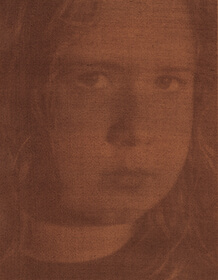
“Elly” by JoLynne Walz Martinez, Village of Oaks, Missouri, USA
Parts used: Petals, Bracts and Stems
Amount: About one cup
Extracted by: Food Processor
Solvent: Rum
Application: Brushing
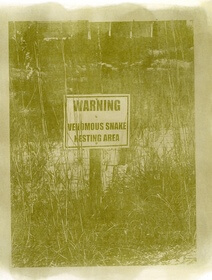
“Snake-protected dune” by Alan Harvey, Tybee Island, Georgia, USA
Parts used: Leaves
Amount: Probably only around 10 grams used for this print (out of a 60-gram batch)
Extracted by: Soaking overnight
Solvent: Isopropyl alcohol
Application: Brushing
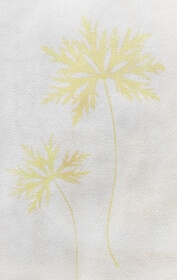
“The World is a Mycelium” by Kazimierz Biernat, Wola Batorska, Poland
Parts used: The young fungal fruit body
Amount: 20 grams
Extracted by: I poured 100 mL of isopropyl alcohol over the sliced mushroom, then let it sit overnight before blending it and straining the mixture through a sock
Solvent: Isopropyl alcohol
Application: Brushing with a foam brush
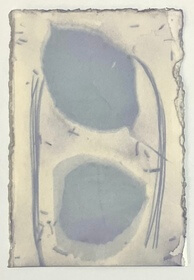
“Blue Rose” by Elaine Lauzon, Hamilton, Ontario, Canada
Parts used: Whole, frozen blueberries
Amount: 1 cup of frozen blueberries
Extracted by: Mortar
Solvent: Isopropyl Alcohol 99%, 2 teaspoons
Application: Brushed on after straining with cheesecloth
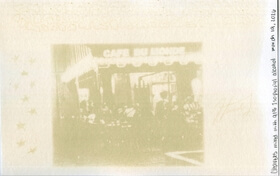
“Café – Oh You Know the One” by Hazel Landaverde, New Orleans, Louisiana, USA
Parts used: Stems and leaves
Amount: A few tablespoons
Extracted by: Blender
Solvent: Cleavers mixed with 91% isopropyl alcohol
Application: Foam brush. I coated paper in March of 2026, but printed in October
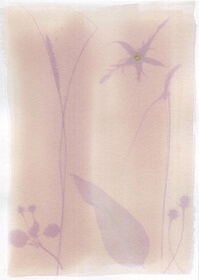
“Untitled” by Ariya Martin and Hazel Landaverde, New Orleans, Louisiana, USA
Parts used: Petals
Amount: A total volume per print was tablespoon
Extracted by: Crushing with a spoon
Solvent: 91% Isopropyl alcohol
Application: Brushing
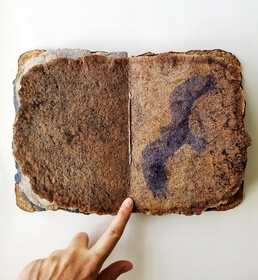
“Harrier” by Oksana Shatalova and Andrey Shatalov, Rudny (Kostanay region), Kazakhstan
Parts used: Berries
Amount: A handful
Extracted by: Trituration in a mortar
Solvent: Tap water and ethyl alcohol
Application: Brushing
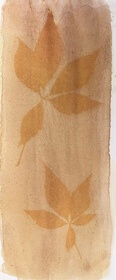
“Summer” by Penny Russell, Bristol, UK
Parts used: Petals
Amount: 2 flower heads
Extracted Mortar
Solvent: Ouzo
Application: Brushing
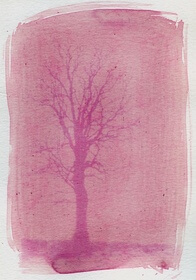
“Winter Tree” by Dianne Bos, Kingston, Ontario, Canada
Parts used: Berries
Amount: About 8 berries or 2 tablespoons
Extracted by: Mortar and soaking
Solvent: Alcohol – vodka
Application: Brush
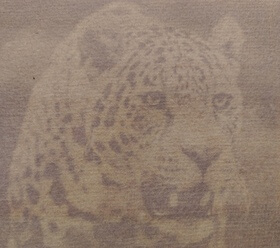
“Onça de Açaí” (Açaí Jaguar) by Narmada Sugasti, Planaltina, Goiás, Brasil
Parts used: Frozen pulp
Amount: 2 tablespoons
Extracted by: Grinding
Solvent: Medium concentration (15%), consisting of 15% concentrated açaí pulp and 85% water. It comes ready-made from the food industry and is known locally as “açaí médio” (medium açaí). No additional solvent was used.
Application: Brushing

“Ferns Unfurled” by Caro Blount-Shah, Bradford, UK
Parts used: Petals of feverfew flowers and blueberry fruits
Amount: A handful of each for each print, approximately 2 tablespoons
Extracted by: Mortar and sieve
Thinner: Filtered water for mashing, then a teaspoon of Gin when sieving
Application: Brushing

“Spotlight” by Tracy Piper-Wright, Ellesmere, Shropshire, UK
Parts used: Leaves
Amount: 14 stems (a good handful)
Extracted by: Blender
Solvent: Tap water
Application: Foam brushing

“Coreopsis ‘self-portrait'” by Fiona Robinson, Salford, Greater Manchester, UK
Parts used: Petals
Amount: A handful for several small prints
Extracted by: Mortar
Solvent: Alcohol (vodka)
Application: Brushing

“Fire Island Breeze” by Ronald D. Butler, Saltaire, Fire Island, New York, USA
Parts used: Berries
Amount: A small handful
Extracted by: Food processor
Solvent: Everclear whole grain alcohol
Application: Brushing

“Pea Pod” by Ralph Rinke, Parksville, British Columbia, Canada
Parts used: Leaves
Amount: Approximately 10 grams mixed with 10 mL of distilled water (only about 2 mL of emulsion was used for the print)
Extracted by: Mortar and pestle
Solvent: Distilled water
Application: Brushing

“Self-portrait” by Bengisu Çaygür, Silifke/Mersin, Turkey
Parts used: Petals and Bark
Amount: Madagascar periwinkle: 3 tablespoons of petals. Mexican fan palm bark: a medium-sized cooking pot, loosely packed (approx. 80 mL of reduced extract)
Extracted by: Madagascar periwinkle: Boiled the petals in water until the colour concentrated into a deep fuchsia emulsion. The petals were removed, and the extract was reduced over low heat and filtered through cheesecloth. Mexican fan palm bark: The cleaned bark was boiled in water, then filtered twice through cheesecloth to remove the resin before reducing over low heat. This produced a dense, rich colour.
Solvent: Tap water
Application: Brushing (synthetic brush)

“Dragonfly” by Jane Linders, St. Louis, Missouri, USA
Parts used: Petals
Amount: Two complete blooms
Extracted by: Mortar
Solvent: I added 10 mL of 91% isopropyl alcohol and 2 mL of deionised water to two crushed and pulverised red canna blooms
Application: Brushing