“Two’s company” by Ray Harris, Bristol, UK
Parts used: Fresh berries
Amount: A handful for each print
Extracted by: Just pressing fruit directly onto the paper
Solvent: None
Application: Pressing fruit directly onto paper, light brushing


“Two’s company” by Ray Harris, Bristol, UK
Parts used: Fresh berries
Amount: A handful for each print
Extracted by: Just pressing fruit directly onto the paper
Solvent: None
Application: Pressing fruit directly onto paper, light brushing

“Self-portrait” by Bengisu Çaygür, Silifke/Mersin, Turkey
Parts used: Petals and Bark
Amount: Madagascar periwinkle: 3 tablespoons of petals. Mexican fan palm bark: a medium-sized cooking pot, loosely packed (approx. 80 mL of reduced extract)
Extracted by: Madagascar periwinkle: Boiled the petals in water until the colour concentrated into a deep fuchsia emulsion. The petals were removed, and the extract was reduced over low heat and filtered through cheesecloth. Mexican fan palm bark: The cleaned bark was boiled in water, then filtered twice through cheesecloth to remove the resin before reducing over low heat. This produced a dense, rich colour.
Solvent: Tap water
Application: Brushing (synthetic brush)

“Photogenic drawing 1/2026” by Goran Budija, Zagreb, Croatia
Parts used: Berries
Amount: A handful of berries
Extracted by: Soaking in 200 mL cheap vodka for 10 days, then ultrasonically treated for 10 minutes (60 w/40 khz)
Solvent: Vodka
Application: Brushing

“Purple Dreams” by Patricia Bromberger, Los Osos, California, USA
Parts used: Petals, both pink and purple
Amount: 24 flowers for each layer
Extracted by: Flowers ground up in a coffee grinder with 30 mL of 91% ethyl alcohol, soaked for 30 minutes, then filtered
Solvent: 91% ethyl alcohol
Application: Brushing with a foam brush

“Untitled” by Viviane Piccoli, Casa Branca, Sao Paolo, Brazil
Parts used: Petals
Quantity: One handful per print, approximately 10 grams
Extracted by: Maceration
Solvent: Tap water and approximately 5 drops of lemon juice
Application: Brushstrokes

“Soft Sangria” by Teresa Guxens, Barcelona, Spain
Parts used: Pieces of apple, beetroot, raisins, orange, and hibiscus (Malus domestica, Beta vulgaris, Vitis vinifera, Citrus, Malvaceae)
Amount: 34 grams of infusion for each print
Extracted by: Mixer
Thinner: Gin
Application: Brushing
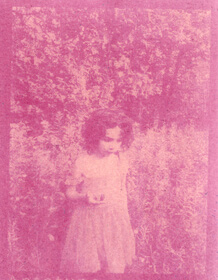
“Lucie with a Butterfly” by Janie Julien-Fort, Montreal, Canada
Parts used: Berry juice
Amount: 2 tablespoons
Extracted by: The berries were frozen; I used the juice.
Solvent: None
Application: Brushing

“Strawberry Fields” by Palle Lindgaard-Jørgensen, Naerum, Copenhagen, Denmark
Parts used: Berries
Amount: A small handful
Extracted by: Mortar
Thinner: Tap water
Application: Brushing

“Alder branch” by Tanya MacGillivray, Halifax, Canada
Parts used: Leaves
Amount: 5 medium-large leaves
Extracted by: Cutting and soaking for several hours
Solvent: 4-5 tablespoons of isopropyl alcohol
Application: Brushing

“Red Maple” by Laurinda Bellew, Wiltshire, UK
Parts used: Leaves
Amount: Three large leaves
Extracted by: Mortar
Solvent: Tap water
Application: Brushing

“Equatorial penguin” by Mónica Páez, Galápagos Islands, Ecuador
Parts used: Fruits
Amount: 1 tablespoon
Extracted by: Mortar
Solvent: Alcohol (crafted sugar cane 45%)
Application: Brushing

“A Clothes Encounter with Birds” by Malin Fabbri, Stockholm, Sweden
Parts used: Leaves
Amount: 10 leaves
Extracted by: Mortar
Solvent: 3 tablespoons of alcohol (isopropyl)
Application: Brushing

“A Memory of Venice” by Karin Matter-Locher, Murten, Switzerland
Parts used: Petals from both plants
Amount: A handful for two prints
Extracted by: Cut into small pieces with scissors, then alcohol (38% ethanol, 62% distilled water)
Application: Sponge